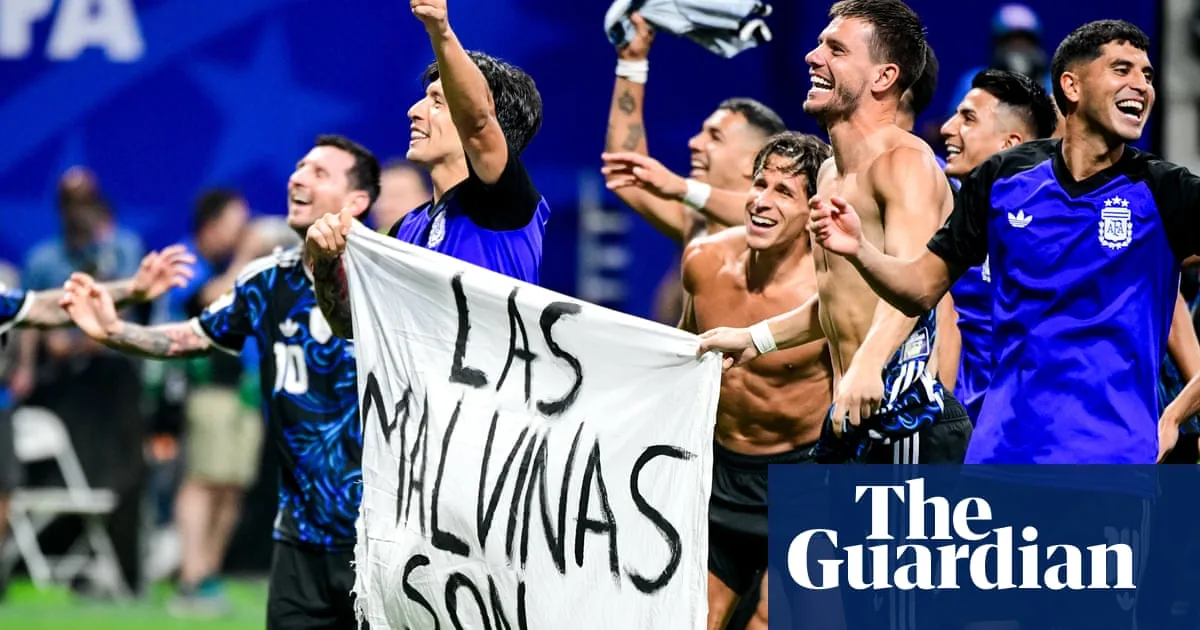
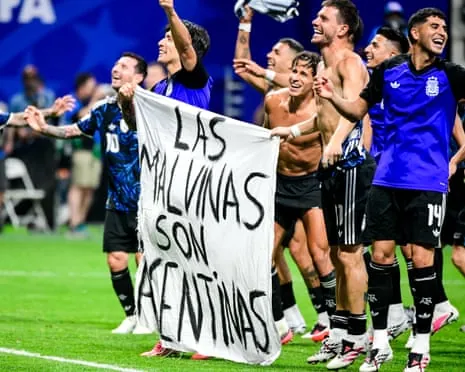
FIFA has initiated a disciplinary review concerning the Argentina national football team after players displayed a banner stating “Las Malvinas son Argentinas” following their 2-1 victory over England in the 2026 FIFA World Cup semi-final. The incident occurred during post-match celebrations in Atlanta.
Players including Lisandro Martínez, Giovani Lo Celso, and Cristian Romero were observed holding the banner. FIFA’s regulations, specifically its Stadium Code of Conduct and Disciplinary Code, prohibit the display of political, ideological, or offensive banners, flags, and slogans during official competitions.
Disciplinary Process Underway
A FIFA spokesperson confirmed that the matter has been referred to the organisation’s independent Disciplinary Committee. This committee is currently evaluating official match reports to determine if any disciplinary action is warranted under the FIFA Disciplinary Code. This procedure is standard for such incidents.
The phrase “Las Malvinas son Argentinas” translates to “The Falklands are Argentinian.” The Falkland Islands, known as Las Malvinas in Argentina, are a British overseas territory situated approximately 480 km off Argentina’s east coast. The sovereignty of these islands has been a long-standing dispute between the United Kingdom and Argentina.
In 2014, Argentina’s football association received a fine of £20,000 from FIFA for displaying a similar banner before a friendly match against Slovenia. At that time, world football’s governing body indicated that the gesture violated rules pertaining to political action and team misconduct.
The dispute over the islands’ ownership dates back to the 19th century. Britain first asserted its claim in 1774 and re-established control in 1832. In 1982, Argentina’s military government invaded the islands, leading to the Falklands War. The conflict, which lasted from April 2 to June 14, concluded with Argentina’s surrender. The war resulted in the deaths of three civilians, 255 British servicemen, and 649 Argentine troops.
Political Reactions and Historical Context
The display of the banner has reignited political discussion. Argentinian Vice President Victoria Villarruel, whose father was a veteran of the Falklands War, commented on the incident. She stated that the Falklands are Argentinian and that while they might be banned from stadiums, they are carried in the hearts of Argentinians. Before the semi-final, Villarruel also referred to England as “usurping pirates.”
Analysts suggest that the banner has brought the Falklands issue back into prominent political discourse in Argentina, partly influenced by the government of President Javier Milei. The status of the archipelago has consistently been a central element of Argentinian national identity.
The Falkland Islands government expressed disappointment over the banner, noting that it was particularly insensitive for many islanders, given the historical context of the 1982 invasion. They hope FIFA will uphold its commitment to keeping politics separate from sport and sanction such behaviour in accordance with its rules.
In the days leading up to the semi-final, Argentinian officials, including Minister of Foreign Affairs Pablo Quirno, reiterated Argentina’s claim to the islands based on historical and legal grounds. Quirno argued that the issue is not one of decolonisation or self-determination but a unique colonial situation resulting from a violation of Argentina’s territorial integrity.
In response, a spokesperson for UK Prime Minister Keir Starmer affirmed that the UK’s position remains unchanged, emphasizing the islanders’ right to self-determination and the UK’s unwavering commitment to the Falklands. A 2013 referendum in the Falkland Islands showed that 99.8 percent of islanders voted to remain a British overseas territory.
At present, FIFA has not announced any sanctions. Argentina is scheduled to play Spain in the World Cup final on Sunday.
Read Also
Source: timesofindia.indiatimes.com