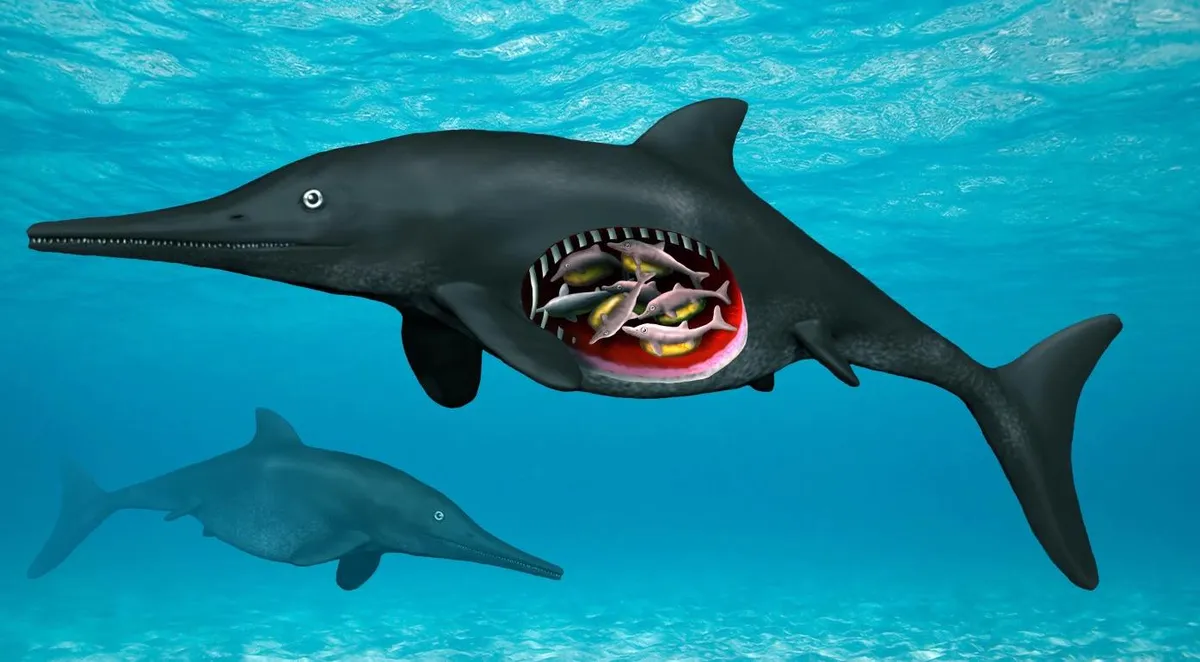
In the quiet town of Mistelgau, Germany, paleontologists have unearthed a 180-million-year-old ichthyosaur fossil that has sent ripples through the scientific community. This specimen, belonging to the genus Temnodontosaurus, measures an impressive 21 feet in length. Yet, it is not merely its size that captivates; it bears severe jaw injuries that challenge long-held assumptions about ichthyosaur survival and feeding adaptations.
The Mistelgau site has been a rich source of marine fossils since excavations began in 1998. This latest discovery provides a nearly complete skull, lower jaw, shoulder girdle, spine, and more than 100 teeth—each element meticulously preserved in the ancient sediment. The presence of gastroliths—stones found in the abdominal cavity—suggests a significant shift in the creature’s feeding behavior, hinting at its struggle for survival amid the Jurassic seas.
Stefan Eggmaier, a lead researcher on the project, remarked on the implications of this find: “The fact that it nevertheless survived is evidenced, among other things, by its heavily worn teeth and gastroliths, which we were able to identify in the abdominal region.” These details paint a vivid picture of how this ichthyosaur navigated its environment despite physical limitations.
Ulrike Albert also noted that their Temnodontosaurus fossil represents one of the youngest finds of this ichthyosaur genus to date. The injuries observed likely significantly limited the animal’s ability to catch prey, raising questions about how it thrived in its marine ecosystem. This discovery not only sheds light on individual survival but also offers insights into the ecological dynamics of Jurassic seas.
The findings provoke thought about convergent evolution—the process where different species develop similar traits as adaptations to similar environments. While this ichthyosaur resembles modern-day dolphins in some aspects, they are not directly related. Such parallels highlight the complex tapestry of life forms that existed during the Mesozoic era.
As researchers continue to analyze this fossil, they anticipate uncovering further details about its life and environment. Observers are eager to see how these insights may reshape our understanding of prehistoric marine survival strategies. The full report detailing these findings has been published in Journal Zitteliana, marking a significant contribution to paleontological literature.
This remarkable ichthyosaur serves as a testament to resilience amid adversity—a narrative echoed throughout Earth’s history.